12.30.2009 |
3 Comments ››
Mark Cousins brings a Kurdish lesson in film-making to London
The exuberant film critic’s tremendous new documentary The First Movie records the triumph of imagination, even over war.
Not many critics also get to be accomplished film-makers, but one such is Mark Cousins, a brilliantly exuberant movie writer whose passionate, celebratory and sensual relationship with the cinema is, I think, a refreshing corrective to the over-snarky tendencies of Fleet Street criticism. Many will know him from the sadly defunct BBC series Scene by Scene, which ran from 1996 to 2001, from his excellent one-volume cinema history The Story of Film and also from his collaborative partnership with Oscar-winning actor Tilda Swinton. It was this partnership which gave birth to the Nairn film festival.
This was, and is, an ongoing experiment in reinventing cinema as a grassroots audience experience, a way of bringing the cinema to people without the intermediate commercial panoply of exhibitors and distributors. Cousins and Swinton created a travelling roadshow, which basically rigged up a white sheet for a screen and a projector, setting up a makeshift auditorium where they can and welcoming everyone inside the tent – as it were. It was a way of finding for the cinema what Peter Brook wanted for the theatre: an empty space, a clear arena in which the artistry of the big screen can be experienced afresh, with films outside the Hollywood canon that would otherwise be beyond most people’s experience.
Something of this approach lies behind Cousins’s tremendous new film, The First Movie, a title which may be a playful twist on Dennis Hopper’s 1971 cult classic The Last Movie. It gets its premiere at London’s ICA Cinema next Monday, followed by a Q&A with the director himself. It promises to be a great evening – particularly with Cousins’s in-the-flesh presence. He is an endlessly stimulating speaker and a great live turn. I have never had a conversation with him without coming away feeling I have learned something, or had new mental avenues opened up to me.
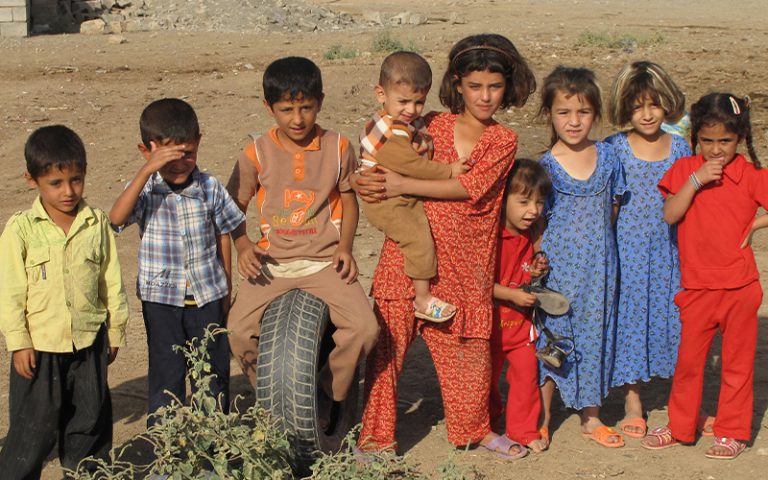
His film is part documentary, part essay, part contemporary memoir, recording his visit to Goptapa in the Kurdish region of northern Iraq, which was the subject of a horrendous chemical assault in 1988, part of Saddam Hussein’s genocidal assault upon the Kurds.
Cousins’s mission was to film the region – and he has some stunning, poetic images – and also to talk to the adults and the children there. But not just that. Cousins does not regard these children as the passive object of his camera lens: the exotic and mysterious bearers of innocence, which is how they are so often seen.
On the contrary. He asks them to be discerning viewers and even makers of films. In the spirit of his Nairn event, Cousins settled them down to watch movies like Astrid Henning-Jensen’s Danish film Palle Alone in the World (1949), about a little boy who wakes up in the world without grown-ups, Mohammad-Ali Talebi’s The Boot (1992) about a little girl who loses one of her red wellington boots, Francesco Stefani’s The Singing Ringing Tree (1957) and Steven Spielberg’s ET: The Extra Terrestrial (1982).
Then he hands out some digital video cameras to the children and asks them to make their own films. The children come back with some remarkable stuff. Some elicit powerful first-person testimony from their mothers and grandmothers about what happened during Saddam’s murderous chemical rain. Another child, using a continuously held camera shot, devises a fascinating and revealing fable of a boy who, without friends or toys, confides his hopes, dreams and thoughts to the mud.
These are, as it happens, children who have never before seen a film – incredible as that seems to western content-consumers who hoover up films on their TVs and iPhones as soon as they can gurgle.
And all this is interleaved with Cousins’s own thoughts about growing up himself in a war zone; Northern Ireland. He says that as meat is tenderised for being battered, so he believes that children need not be hardened by this – and that the life of the imagination is what is real, more real than war.
If all this sounds pseudy, I can only say that it isn’t. This is a terrifically enjoyable and engaging film: open-minded and open-hearted, and utterly unlike the material on regular commercial release. Next Monday night’s showing of The First Movie promises to be a tremendous, exhilarating event. We can always do with those.
By Peter Bradshaw
http://www.guardian.co.uk/film/filmblog/2009/dec/10/mark-cousins-the-first-movie
> Read More
12.30.2009 |
No Comments ››
Screen Siren Pictures is the co-producer of a film that director Mark Cousins recently shot in Iraq. The First Movie is a magical 76 minute documentary about kids and cinema and war. It has its world premiere at the ICA in London on 14th December at 6.45pm, we’d love you to come along and support the film. Mark will… be there for a Q&A.
The film is made with the support of Scottish Screen, More 4, Knowledge, ARTE, The Canadian Television Fund, The Shaw Rocket Fund and YLE.
Time:6:45PM | Location:ICA, London
http://www.ica.org.uk/The%20First%20Movie%20plus%20Mark%20Cousins%20Q%26A+22984.twl
> Read More
10.07.2009 |
No Comments ››
The First Movie: peace through a child’s eye.
Mark Cousins shines with this powerfully artful documentary about the opposite of war: children’s imaginative lives.
The mother says: “There were as many soldiers as a tree has leaves.”
It’s a film called The First Movie, and she’s talking about the Anfal of twenty years ago — the name given to eight military offensives (1987-89) by the Baath regime under Saddam Hussein. For her and her isolated village, the Anfal is the infamous May 3, 1988, genocidal rain of chemicals from helicopters, accompanied by mass detainment, torture and “disappearances”. The “ethnic cleansing” devastated her village of Kurds and left 14 per cent — one seventh — of the population dead in a day.
Mark Cousins, a British film-maker of preternatural sensitivity and solid success making documentaries (BBC’s Scene by Scene for five years, films on Neo-Nazism, Gorbachev and Michael Powell), has directed this powerfully artful documentary about the opposite of war: children’s imaginative lives. He lets the fact of the genocide sink like a single stone to the bottom of a river that bubbles exuberantly overhead with the life force of children’s dreams and activities.
Cousins travelled to a Kurdish village called Gotapa, in northern Iraq, 80 miles from the Iranian border. It’s an isolated farming community of 700 in the baking desert of herded animals, irrigated crops and an oil refinery under construction. In one small mosque men pray and kids giggle and make faces in the back row.
Because it’s Ramadan and the adults are indoors fasting while the kids roam freely, it’s the children we get to know. The high-spirited boy with the gap-toothed grin. The boy who wears his pants high on his chest. The girl in the purple dress who runs to catch up with her goats after savouring a pomegranate. The little-girl gang wielding their Barbies like sceptres. And Little Mohammed, who shows a spontaneous talent for movie-making.
You can see the film The First Movie — and I’m urging you to — tomorrow night on More 4, following its premiere this week at the ICA in London. The First Movie is an achingly lyrical story of honesty, honour and hope in a postwar landscape that looks like mounds on the Moon. Mud, dust going gold in the sun, wheat fields peopled with shadows, a pearly landscape of sentinel trees (“where lovers meet”), in a land that time forgets.
Cousins and his editor took a camera, projector, laptop editing suite, a few “flip” mini-video cameras for the village children, a generator and hard-won permissions from the Iraqi Ministry of Culture. Cousins’s experiment was to see how imagination in children might be affected by a lineage of regional violence. In spite of no cinemas, brownouts and secret police who want the film crew to be Aids-tested, Cousins was able to invent a film culture for the children in three weeks. He showed them their first movies in a makeshift theatre of strung-up sheets, then passed out cameras to a half-dozen children to make their own movies.
And they did.
One child makes a movie about a fish who lives in a magical palace, one about a chicken who teaches justice. Another wants his film to be about “love and freedom: like roses, we should be together,” the tyke astonishingly declaims. Little Mohammed, a favourite, films a boy playing with mud “who gives his wishes to the water”.
Cousins attends to detail, recreating the pace of a landscape where goats, chickens, geese, a brown cow and a sleepy dog are featured players. The colours thrill: flapping fuchsia, orange and yellow sheets, the changing sky, a red clothing of a small girl.
The film score by the Hong Kong- Canadian composer Melissa Hui is perfect. With a fusion (profusion) of images, a few camera wizardry tricks, and an insightful, poetic commentary, The First Movie delivers a-ha moments like wheat cakes. Cousins travels into the place where Derek Jarman often took us — that liminal, vibratory state which shows you the world as a fireworks seen through tree branches — to reference one of Cousins’s memorable shots.
In Iraq, he’s chosen five movies for the children to see: ET, Iran’s The Boot (Iran), Palle Alone in the World (Denmark), The Singing Ringing Tree (East Germany) and The Red Balloon. The kids cheer, jump up and down, try to touch the balloons in the air . . . cineastes will love this bit.
I talked to Cousins — he’s living in Edinburgh (and is a past director of the Edinburgh Festival and a film and art historian with four books to his credit, including The Story of Film). He and the Oscar-winning actress Tilda Swinton are famous for their tours in a van of Scotland and Beijing with a traveling circus of films beyond the multiplex offerings, The Cinema of Dreams. He comes from Belfast: “My mother was Protestant, my father Catholic — a Romeo and Juliet scenario with a happy ending,” he says. He found himself as a child not wounded so much as “tenderised” by armed conflict. “War is less real to a child than imagination. War inadvertently gives to children heightened awareness, peripheral vision. I made my first movie at the age of 8.” About First Movie, he says: “I’m interested in the camera as an empathy machine. War doesn’t kill beauty.” Cousins’ next project is “the story of creativity in film,” 12 hours told in 12 parts — a brave lad.
The First Movie celebrates delicacy, vigour and the opening of horizons without being cloying. Mark Cousins’s letter to the boy after returning says it all: “Mohammed, I’m here in Edinburgh, where there are no jackals.”
- Ken Russell
http://entertainment.timesonline.co.uk/tol/arts_and_entertainment/tv_and_radio/article6960692.ece
> Read More